


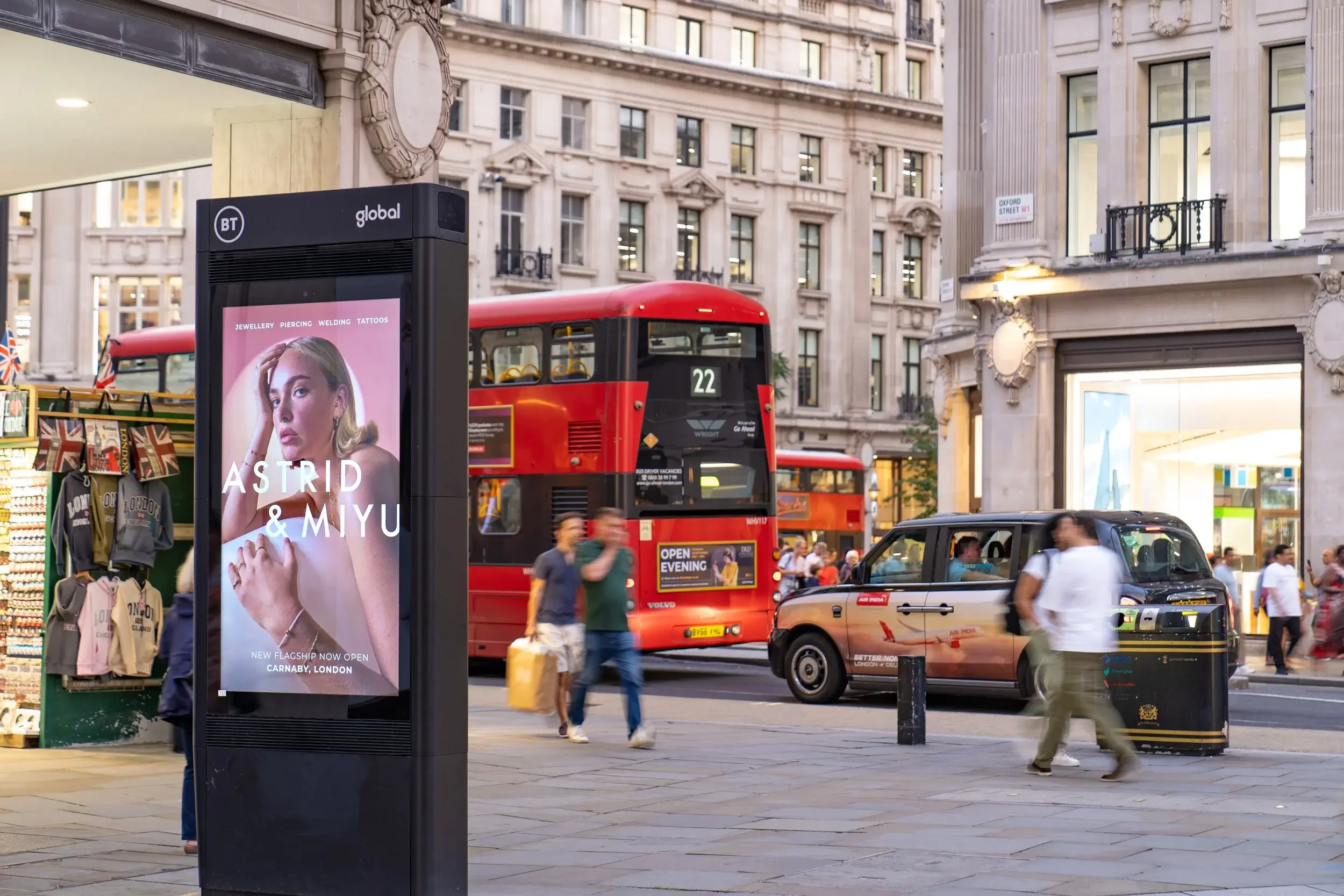
Out-of-home advertising, often shortened to OOH advertising, is advertising that reaches people when they are outside their homes. It appears in the places where daily life happens: on roads, in stations, across shopping areas, beside transport routes, inside airports, at bus shelters, on taxis, on buses, and across digital screens in busy public spaces.
That is the simple answer. The better answer is this: OOH gives brands a physical presence in the real world.
While online ads compete for attention on crowded screens, OOH advertising becomes part of the environment. It appears during commutes, shopping trips, lunch breaks, school runs, nights out, airport journeys and everyday routines. People do not need to click, scroll, subscribe or search to see it. The message is already there, placed where audiences naturally move.
For brands looking to build visibility at scale, OOH ads remain one of the most dependable ways to make a campaign feel established, confident and hard to ignore.
Why OOH Advertising Still Matters
Marketing has become heavily digital, but that has not made physical advertising less important. If anything, it has made real-world visibility more valuable.
People are exposed to huge volumes of online content every day. Many digital messages are skipped, blocked, muted or forgotten within seconds. OOH advertising works differently. It is public, visible and repeated. A well-placed billboard or transport campaign can be seen by thousands of people every day, often at the same point in their routine.
That repetition matters. A commuter may see the same campaign on the way to work each morning. A shopper may pass the same high street screen several times a week. A driver may notice the same roadside billboard on a regular journey. Over time, the brand becomes familiar.
Familiarity is one of the quiet strengths of OOH. It does not always need to ask for immediate action. Sometimes its job is to make sure that when a customer is ready to buy, enquire or compare options, the brand already feels known.
The Main Types of OOH Advertising
OOH advertising includes a wide range of formats. Some are large and dramatic. Others are more local, tactical or targeted. The right choice depends on the audience, location, budget and campaign goal.
1) Billboard advertising
Billboards are one of the best-known OOH formats. They are built for scale, clarity and impact. A strong billboard can deliver a simple message to drivers, pedestrians and passengers in seconds.
For brands exploring billboard advertising in UK locations, the biggest advantage is visibility. Roadside billboards, large-format displays and premium city placements help brands create a strong public presence quickly.
Billboards are especially useful for launches, brand awareness campaigns, national promotions, entertainment releases, retail offers, property campaigns and financial services. The creative needs to be simple, but the impact can be significant.
2) Digital out-of-home advertising
Digital out-of-home, often called DOOH, uses digital screens instead of printed posters. These screens can display moving creative, timed messaging and multiple adverts in rotation.
The flexibility is a major advantage. A brand can run different messages by time of day, switch creative quickly, promote limited-time offers or adapt campaigns around events and seasonal moments. Digital screens work particularly well in shopping centres, transport hubs, airports, roadside environments and city centres.
DOOH also helps brands bridge the gap between outdoor and digital marketing. QR codes, social prompts, mobile retargeting and campaign-specific landing pages can all be used to connect public visibility with online action.
3) Transport advertising
Transport advertising places brands across buses, taxis, trains, trams, stations and other travel environments. It works because movement extends reach.
A static billboard stays in one place. A bus wrap or taxi campaign travels through different streets, neighbourhoods and business areas. That gives the campaign a sense of motion and allows brands to appear across multiple audience touchpoints.
Transport media is particularly strong in major cities, where people move constantly between work, retail, leisure and travel locations.
4) Street furniture advertising
Street furniture includes bus shelters, kiosks, information panels, benches and other public structures. These formats are often positioned close to pedestrians and local traffic, making them useful for neighbourhood targeting.
A bus shelter campaign, for example, can reach commuters with longer dwell time, while high street panels can influence shoppers close to the point of purchase. These placements may be smaller than billboards, but they can be very effective when location matters.
5) Airport and retail OOH
Airports, malls and retail destinations offer high-value advertising environments. Audiences often have time to notice and absorb messages, especially in waiting areas, arrival halls, lounges, concourses and shopping walkways.
These locations are useful for luxury, travel, finance, technology, automotive, fashion and lifestyle brands. They offer context as well as visibility, placing the brand in environments where people are already thinking about purchases, travel, experiences or upgrades.
How OOH Advertising Works for Brands
The strength of OOH advertising comes from a combination of reach, location and creative simplicity.
A successful campaign starts with audience planning. Who does the brand need to reach? Where do those people travel, work, shop or spend time? What kind of message will make sense in that environment?
From there, media planners select formats and locations that match the campaign objective. A brand wanting national fame may choose large-format roadside billboards across several cities. A retailer promoting store visits may focus on sites close to key branches. A B2B brand may prioritise transport hubs, business districts and airport placements.
Creative is then developed around the way people will see the ad. This is important. OOH is not a brochure. Most people see outdoor ads while moving, so the message must be easy to understand quickly. Strong visuals, short copy and a clear brand presence usually work better than crowded layouts.
The best OOH campaigns often do one thing very well. They introduce a brand, launch a product, make an offer memorable or reinforce a message through repeated exposure.
Out of Home Advertising in the UK
The UK is one of the most established markets for OOH media. From London Underground panels and roadside billboards to regional transport campaigns and digital city screens, brands have access to a wide mix of formats and locations.
For businesses considering out of home advertising in UK markets, the opportunity is not limited to London. Major cities such as Manchester, Birmingham, Leeds, Glasgow, Edinburgh, Liverpool, Bristol and Cardiff all offer strong outdoor advertising environments.
Each market behaves differently. London offers scale, density and premium transport media. Regional cities can provide strong commuter reach, retail influence and local relevance. A national brand may want broad coverage, while a local business may need careful placement around specific catchment areas.
That flexibility is one of the reasons OOH remains useful. It can support both large national campaigns and tightly planned local activity.
Outdoor Advertising in the UK and Real-World Trust
There is also a trust factor attached to outdoor media. When people see a brand displayed publicly, especially in recognised locations, it can create a sense of legitimacy. The brand feels present. It feels active. It feels established.
That does not mean OOH should be used without strategy. Poor creative in the wrong location will still underperform. But when the placement, message and audience are aligned, outdoor campaigns can add weight to a brand in a way that many smaller digital placements cannot.
This is why outdoor advertising in UK campaigns are often used alongside search, paid social, TV, radio and PR. OOH builds awareness in the real world, while digital channels capture intent, retarget interest and measure response.
The channels do not need to compete. They work better together.
What Makes a Strong OOH Campaign?
A strong OOH campaign is usually built around five practical choices.
1) A clear campaign goal
The campaign should know what it is trying to achieve. Is the aim awareness, store visits, enquiries, app downloads, event attendance or brand fame? The goal shapes everything else.
2) The right locations
OOH is location-led. A good placement reaches the right audience at the right moment. This may mean commuter roads, rail stations, shopping districts, airports, business areas or leisure destinations.
3) Simple creative
Outdoor creative needs discipline. A strong image, short message and clear brand identity will usually outperform a design filled with too much information.
4) Repetition
One exposure can be useful. Repeated exposure is stronger. OOH works best when people see the message often enough for it to become familiar.
5) A connected response path
Modern OOH can drive action when it connects clearly to the next step. This might be a memorable URL, a search-friendly brand name, a QR code, a promotion, a landing page or a wider digital campaign.
Is OOH Advertising Measurable?
Yes, although it is measured differently from purely digital media.
OOH measurement often includes estimated reach, impressions, traffic data, footfall, audience profiles, location performance and campaign visibility. Digital OOH can add further reporting based on play-outs, screen activity and scheduling.
Brands can also measure the effect of OOH through website traffic, branded search uplift, sales patterns, QR scans, promo codes, social activity and post-campaign brand awareness studies.
The key is to define success before the campaign goes live. A brand awareness campaign should not be judged only by instant sales. A retail campaign should be planned with store proximity and response tracking in mind. A launch campaign may need reach, frequency and online search impact.
OOH is measurable, but it needs the right framework.
Why Brands Choose OOH Advertising
Brands choose OOH because it gives them scale, visibility and public presence. It can make a small brand feel bigger, a launch feel louder and an established brand feel more familiar.
It also reaches people in moments that digital media may miss. On the road. At the station. In the airport. Near the shop. Outside the event. Across the city.
That real-world presence is valuable because people still live, travel and make decisions offline. The most effective campaigns understand this. They do not treat OOH as old-fashioned media. They use it as a visible layer in a wider marketing strategy.
When planned well, OOH advertising does more than fill space. It creates recognition, trust and momentum.
Bringing Your Brand Into the Public Eye
OOH advertising remains one of the most powerful ways to put a brand in front of people at scale. Whether the format is a roadside billboard, a digital screen, a transport wrap or a targeted street-level placement, the principle is the same: be seen where your audience already is.
For brands planning campaigns across the UK or internationally, OOH offers the chance to move beyond fleeting online impressions and build a visible presence in the real world.
If you are exploring outdoor formats, planning a launch or looking for stronger brand visibility, OOH International can help shape a campaign around the right locations, formats and audience strategy.
FAQs
What does OOH advertising mean?
OOH advertising means out-of-home advertising. It refers to ads seen outside the home, including billboards, digital screens, transport ads, street furniture, airport media and retail displays.
What are examples of OOH ads?
Common OOH ads include roadside billboards, bus shelter posters, taxi ads, bus wraps, train station panels, airport screens, shopping centre displays and digital outdoor screens.
Is OOH advertising effective in the UK?
Yes. OOH advertising is effective in the UK because it reaches people during daily routines across roads, stations, retail areas, airports and city centres. It is especially useful for brand awareness and repeated visibility.
What is the difference between OOH and outdoor advertising?
Outdoor advertising is often used to describe roadside and public outdoor formats such as billboards and posters. OOH is the broader term and can also include transport, airport, retail, mall and indoor public-space advertising.
How do brands measure OOH advertising?
Brands measure OOH through reach, estimated impressions, location data, footfall, branded search uplift, website traffic, QR scans, promo codes, sales changes and post-campaign awareness studies.